
Budget Season Opens: USDCx, Node Diversity, and Your Vote on the 2026 Framework
Expires: 25th Mar 2026 (Epoch 621)

GM DReps. A lot has moved since we last landed in your inbox. This edition catches you up on the key governance actions, walks through two proposals that deserve your close attention, and breaks down what USDCx means for the ecosystem you govern.
TL;DR – Five Key Takeaways
The Constitutional Committee size reduction from 7 to 5 members was rejected by the community.
Two new treasury withdrawal proposals are now on-chain: Amaru 2026 and Dingo by Blink Labs.
Intersect’s Cardano Budget Process Framework has been submitted on-chain — DRep vote needed.
USDCx (a Circle-backed USDC stablecoin) was launched on Cardano.
Budget season is open. The treasury runway is set at ₳350M. Proposal submission opens in April.
Cardano Budget Process Framework
Intersect's Budget Committee has submitted an Info Action proposing the formal framework for how the 2026 Cardano ecosystem budget cycle will run. See the deep-dive section below.
This is an Info Action, not a spending decision. Voting YES does not allocate a single ada. What it does is signal that you support using this structured process to organise the 2026 budget cycle. If it reaches majority support (>51% of active voting stake), the submission window opens and proposals can begin to be collected.
Why this vote matters for DReps
The 2025 budget cycle worked, but it was rough. Proposals came in inconsistent formats, comparison was difficult, the review load was heavy, and on-chain thresholds often did not align with off-chain processes. This framework is the community’s attempt to fix that — before the next wave of proposals lands on your desk.
The five-stage cycle
Planning — strategic vision, NCL, and budget framework preconditions confirmed on-chain. All three are now in place for 2026.
Proposal submission — standardised template, minimum proposal size of 100,000 ada, and a 1,000 ada treasury contribution to reduce low-quality submissions.
Community review and refinement — draft proposals visible to the community, proposers can iterate based on feedback before the window closes.
Off-chain DRep advisory voting — proposals that achieve at least 67% support from participating DRep stake (via Ekklesia/Hydra) advance to on-chain stage. This threshold filters proposals before the formal on-chain vote, reducing voting fatigue.
Execution — approved treasury withdrawals are administered by Intersect using milestone-based smart contract disbursements, with an independent Oversight Committee providing checks and balances.
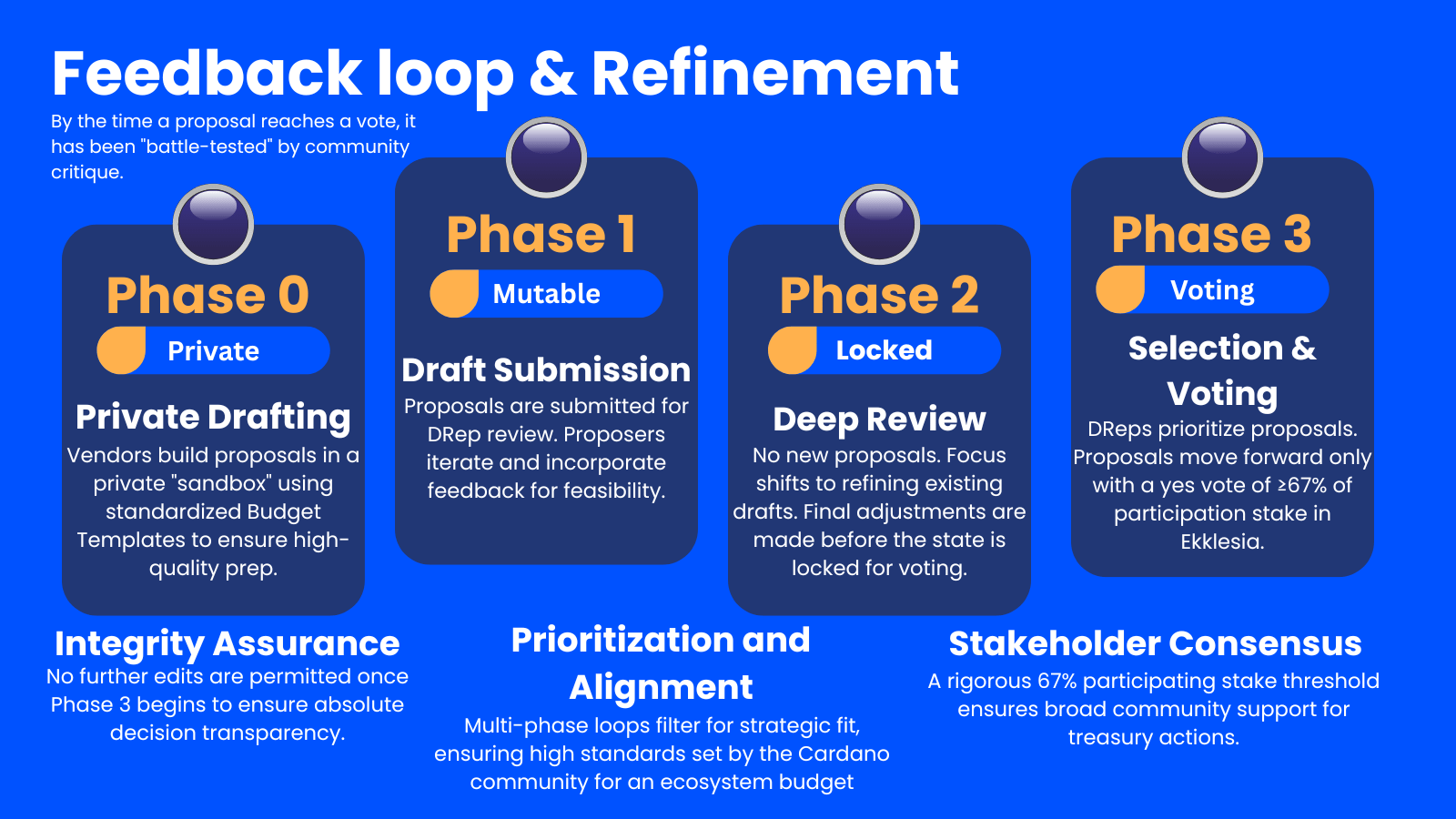
Key differences from 2025
All proposals use a standardised template — apples-to-apples comparison across initiatives
Proposals must map to Cardano Vision 2030 KPIs — so DReps can evaluate expected ecosystem impact, not just narrative
Once voting begins, proposals are locked and cannot be edited — protecting fairness and aligning the on-chain vote with a fixed off-chain reference
Participation is optional — proposers can still submit Treasury Withdrawal actions independently through standard governance mechanisms
📊 Read the full framework: Building a 2026 Ecosystem Budget for Cardano
🗳️ Vote on the governance action: Cardano Budget Process Framework
CC size reduction rejected
The proposal to reduce the minimum Constitutional Committee size from 7 members to 5 did not pass. Low participation from the community signalled that perhaps a larger, more distributed committee remains the right safeguard at this stage of governance maturity. Worth noting for any future parameter discussion: the threshold and rationale for CC membership size will continue to be a live conversation.
Amaru Treasury Withdrawal 2026
Amaru is a production-grade Cardano node implementation written in Rust, developed under the PRAGMA open-source association. Budget season 2026 is now open, and Amaru was the first proposal of the new cycle to hit on-chain — submitted as a Treasury Withdrawal action, covering the next phase of development.
Node client diversity is a core resilience factor for Cardano. Amaru is one of the projects that reduces reliance on a single implementation. This is a direct funding ask from the treasury — read the proposal before voting.
Dingo by Blink Labs
Having concluded the first series of workshops for this milestone, the Beyond MVG team is now preparing to facilitate further sessions as part of Milestone 3. These upcoming workshops will continue the project’s mission of refining Cardano’s governance through community-driven data.
Join our upcoming X Space workshop: We will be hosting a similar workshop on X Space on 18th February 2026 at 16:00 UTC. You can join the session here [add link from Matthew Coops].
Access the Findings: A comprehensive summary and key insights from the initial workshops are available for public review via Beyond Minimum Viable Governance (MVG) Governance Experience Insights Workshops.
USDCx launched on Cardano.
What is USDCx?
USDC is a fiat-backed stablecoin issued by Circle — one of the most widely used dollar-pegged assets in crypto. USDCx is a wrapped version of USDC that can circulate natively inside the Cardano ecosystem, giving developers and users access to a fully regulated, dollar-denominated asset on-chain.
USDCx works in tandem with Circle Gateway and Circle CCTP, making it interoperable with USDC across supported blockchains without relying on third-party bridges.
👉 Learn more about USDCx on Cardano here: https://usdcx.iog.io/faq
Why DReps should care
Stablecoins are critical DeFi infrastructure. Without a reliable, regulated on-chain dollar, Cardano DeFi protocols face a ceiling on institutional adoption, liquidity depth, and settlement reliability. USDCx addresses that gap directly.
For governance specifically, several threads connect here:
Treasury-funded work is delivering visible outputs. The Critical Integrations Budget is not an abstraction — USDCx is a signed agreement.
Future proposals in DeFi, liquidity, and RWA verticals will operate in a materially different environment once USDCx is live. Factor that into how you evaluate those funding requests.
Bridge risk and custodial risk — longstanding topics in Cardano governance discussions — are directly affected by whether Circle-native USDC is available. This reduces the dependence on third-party bridge solutions.
Your vote → Real-world outcome
USDCx is the most visible near-term proof point that DRep votes produce ecosystem-level change. You approved the Critical Integrations Budget. Pentad signed with Circle. That chain of accountability runs directly through your ballot.
What is coming next
Budget season 2026 is fully open. The treasury runway is set at ₳350M. The framework vote is live. Proposal submission opens in April. Between now and June, DReps will be doing the most consequential work of the governance year — reviewing proposals, weighting ecosystem impact, and casting on-chain votes that determine how Cardano’s treasury is deployed for the next 12 months.
🔔 All Active Governance Actions
Participation is the system-wide constraint. Below are the deadlines for all active governance actions.
Thanks for reading. If you’d like to support our work in the DRep Forum, please share this post.