
Net Change Limit Nearly There. One Small Push to Lock in the 2026–27 Treasury Runway
Expires: 8th Feb 2026 (Epoch 612)

GM DReps. This edition is a short governance check-in for DReps. The updated Constitution is now in force, the Cardano budget Administrator is operating, and the next Net Change Limit is already close to approval.
The NCL defines the treasury runway for the 2026–27 period. A small amount of additional DRep participation will confirm the ceiling and keep treasury-funded work moving smoothly under the new constitutional rules.
The Cardano treasury-funded work to analyze and recommend improvements to Cardano's governance structure is underway. Find the links to get involved and stay up to date in this post.
TL;DR – Five Key Takeaways
The Net Change Limit currently sits at 50.05% DRep support. The Net Change Limit currently sits at 50.05% DRep support. If it stays above 50% by the end of the epoch, it will clear the constitutional threshold and pass with a YES vote.
If passed, the Net Change Limit will begin at the start of Epoch 613 on 13 February 2026 and conclude at the end of Epoch 713 on 3 July 2027. It sets a ceiling of 350M ada, and unless a new NCL is approved this is the maximum that can be withdrawn from the treasury during that period.
The updated Constitution is now in force, with >79.8% of active DRep voting stake having approved it. It simplifies funding by folding the old Budget Info Action into Treasury Withdrawals, tightens rules so linked documents must be immutable and all withdrawals carry audit-style safeguards, and cleans up definitions so thresholds and roles are easier to reason about.
Intersect has six months of track record as the Cardano budget Administrator, currently administering 345M $ada with contracts, milestones, evidence and audits.
Pentad has signed the USDCx integration agreement with Circle, marking progress on the critical integrations work funded through governance. Through this integration, USDCx will soon be available, providing a USDC-backed stablecoin to developers and users and enabling access to crosschain USDC liquidity.
Beyond Minimum Viable Governance
The Cardano treasury-funded work to analyze and recommend improvements to Cardano’s governance structure is underway—find the links to get involved and stay up to date.
This work is focused on gathering practical input from ADA holders, DReps, SPOs, Constitutional Committee members, governance tooling & data providers, and community project leaders.
The team behind Beyond Minimum Viable Governance (Beyond MVG) has published an updated set of links - linktr.ee/BeyondMVG - covering its ongoing workshops and surveys—they’re looking to learn from you!
Having concluded the first series of workshops for this milestone, the Beyond MVG team is now preparing to facilitate further sessions as part of Milestone 3. These upcoming workshops will continue the project’s mission of refining Cardano’s governance through community-driven data.
Join our upcoming X Space workshop: We will be hosting a similar workshop on X Space on 18th February 2026 at 16:00 UTC. You can join the session here [add link from Matthew Coops].
Access the Findings: A comprehensive summary and key insights from the initial workshops are available for public review via Beyond Minimum Viable Governance (MVG) Governance Experience Insights Workshops.
Register for the Beyond MVG X Space
This workshop captures concrete examples, dependencies, and desired outcomes. These insights are synthesized into evidence-backed observations that help the Beyond MVG project identify priority governance improvements, align them with measurable metrics, and inform actionable next steps, including CPS or CIP drafts.

The Net Change Limit in plain language
The Net Change Limit is a constitutional parameter, not a spending decision. Its purpose is to define the maximum amount that can be withdrawn from the treasury over a specific period, allowing individual Treasury Withdrawals to be assessed against a known ceiling rather than in isolation.
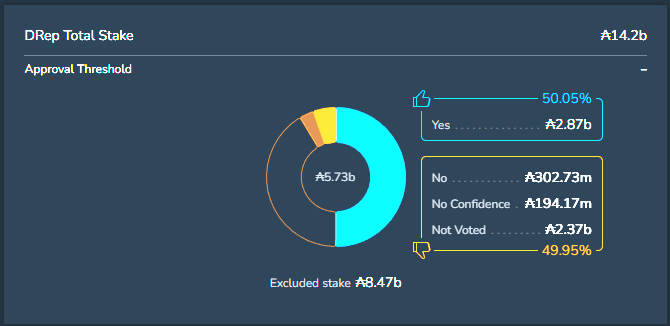
For this cycle, the proposed Net Change Limit would apply from the start of Epoch 613 on 13 February 2026 through to the end of Epoch 713 on 3 July 2027. During this window, the total amount withdrawn from the treasury cannot exceed ₳350M unless a new Net Change Limit is approved.
This structure separates capacity from allocation. The Net Change Limit sets the outer boundary. Decisions about which projects are funded, when, and why come later through individual Treasury Withdrawals, each of which must meet the constitutional requirements for documentation, immutability, and accountability.
The Cardano Constitution v2.4 is now in force
The updated Cardano Constitution is now the reference text for every on chain governance action. A key change is how funding is structured. The old Budget Info Action has been removed, along with various expectations and encouragement clauses.

Instead, Treasury Withdrawals now carry the full burden of justification and accountability. Each withdrawal must stand on its own, with its purpose, rationale and supporting information contained in that action.
The Constitution also locks down the artefacts DReps are asked to read. Any document linked by URL must be immutable once submitted, so what you review and vote on cannot be changed afterwards. This aligns the on chain decision with a single, fixed off chain reference.
Finally, definitions have been cleaned up. Terms such as Active Voting Stake, DRep, SPO, Net Change Limit and Treasury Withdrawal Recipient are now defined once and used consistently. That makes thresholds and outcomes easier to understand when you read future governance actions.
You can read the full text here if you want the detail:
You passed the ₳70M critical integrations budget. Now USDCx is arriving on Cardano.
You approved the ₳70M Critical Integrations Budget to bring missing infrastructure to Cardano. The USDCx integration agreement between the Pentad and Circle is one of the first visible outcomes of that push, giving Cardano a Circle backed dollar rail for DeFi and settlement.
Cardano integration to Circle has begun. Through this integration, USDCx will soon be available, providing a USDC-backed stablecoin to developers and users and enabling access to crosschain USDC liquidity.
xReserve works in tandem with Circle Gateway and Circle CCTP to make USDCx interoperable with USDC across supported blockchains, without reliance on third-party bridges.

Intersect is now executing treasury work under permanent leadership
Over the last six months, Intersect has moved from “setting up” the Administrator role to actually running it day to day. It is administering roughly ₳345M of previously approved treasury work using contracts, milestones, delivery evidence and audits, inside the guardrails defined by the Constitution.
In practice this means that when a governance action is approved, it does not stop at an on chain tick box. Intersect turns it into legal contracts and on chain vendor contracts, tracks milestones against what DReps voted for, checks the evidence, and only releases payments when agreed criteria are met. If something is late or incomplete, payments can be paused until it is resolved. Delivery data is also being opened up through public dashboards and an administration API so others can inspect and build on it.
Intersect has also moved from interim to permanent leadership. Jack Briggs has now been appointed Executive Director of Intersect after serving in the role on an interim basis. That closes the loop on this being a temporary setup. There is a named person accountable for how the Administrator runs and how it serves the ecosystem over time.

🔔 All Active Governance Actions
Participation is the system-wide constraint. Below are the deadlines for all active governance actions.
Thanks for reading. If you’d like to support our work in the DRep Forum, please share this post.